

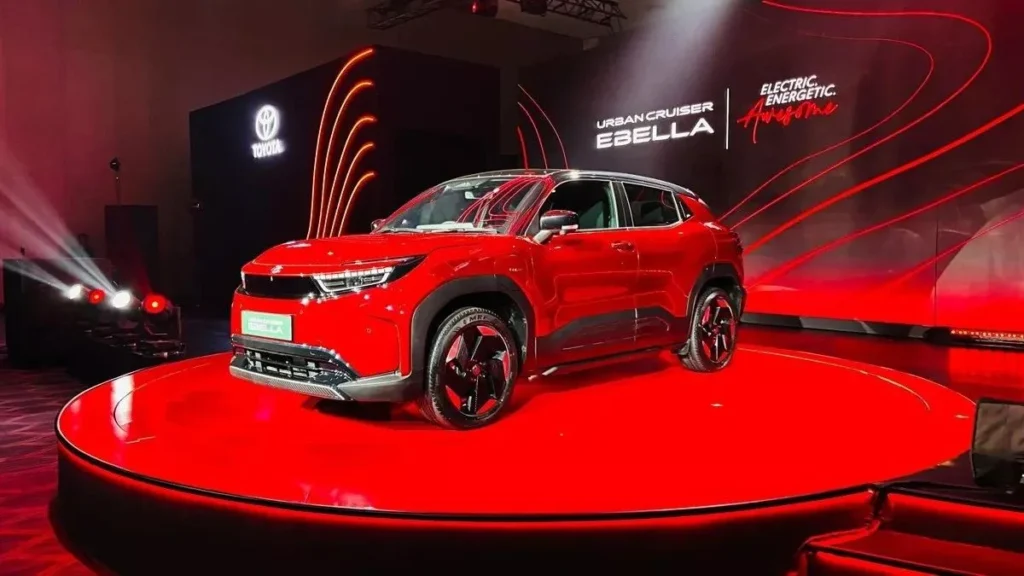
Hey there, fellow car enthusiasts—if you’ve been keeping an eye on India’s electric vehicle scene, you know things are heating up faster than a summer afternoon in Delhi. Toyota, the brand that’s practically synonymous with bulletproof reliability, is finally dipping its toes into the pure EV pool with the Urban Cruiser Ebella. And the timing? Spot on. With deliveries kicking off in March 2026, this mid-size electric SUV is poised to shake things up in a market dominated by Tata and Mahindra. I’ve been following Toyota’s moves since their hybrids first rolled in, and let me tell you, this one’s got me genuinely excited. It’s not just another badge-engineered job; it’s Toyota’s first all-electric offering tailored for Indian roads, complete with that signature peace-of-mind warranty.
But why now? Well, with EV sales surging 44% in February alone and government incentives pushing adoption, Toyota couldn’t sit on the sidelines forever. The Ebella—built on the Heartect-e platform shared with Maruti’s eVitara—promises a blend of urban agility, family-friendly space, and Toyota’s renowned after-sales support. In this deep dive, we’ll unpack the launch details, pricing, specs, and what makes (or might break) this EV for everyday drivers like you and me. Whether you’re commuting in Kolkata traffic or planning weekend getaways, stick around—I’ve got the full scoop.
Toyota Urban Cruiser Ebella EV: A Quick Backstory Before the March 2026 Launch
Toyota’s EV journey in India isn’t starting from scratch. They’ve been electrifying the market with hybrids like the Innova Hycross and Camry for years, racking up over 38 million electrified vehicles globally. But pure battery-electric? That’s new territory. The Urban Cruiser Ebella was unveiled back in January 2026 at a glitzy event in Mumbai, turning heads with its bold stance and tech-heavy cabin. Pre-bookings opened immediately with a modest ₹25,000 token, and over 10,000 slots filled up in the first week—proof that Toyota’s badge still carries weight.
Come March 2026, expect the full rollout: showrooms stocked, test drives aplenty, and deliveries starting for early birds. Why the slight delay post-unveil? It’s all about fine-tuning for Indian conditions—think pothole-proof suspension tweaks and localized software for our chaotic charging ecosystem. If you’re eyeing one, I’d say start saving now; this isn’t a budget beater, but it’s got premium aspirations without going full luxury.
Design and Dimensions: Built for Indian Streets, Styled for the City Slicker
Let’s talk looks first because, honestly, the Ebella’s design is where it shines—or at least tries to. At 4,285mm long with a generous 2,700mm wheelbase, it’s smack in the sweet spot between compact and mid-size SUVs. Ground clearance sits at 184mm, which should handle speed breakers without a whimper, though it’s a tad lower than rivals like the Tata Curvv EV’s 200mm. The boot? A practical 306 liters, expandable with folding rear seats—perfect for grocery runs or that occasional IKEA haul.
Externally, it’s got that muscular crossover vibe with chunky black cladding, 18-inch alloys, and a blanked-off grille that screams “EV” without shouting. Up front, slim LED headlights connected by a chrome strip flank vertically stacked DRLs, giving it a modern, almost frowning expression. I love the connected LED taillights at the rear—they add a premium touch, especially in the two-tone color options like Sportin’ Red with Black Roof or Cafe White with Black Roof. There are nine shades in total, from Gaming Grey to the earthy Land Breeze Green, so there’s something for every mood.
Inside, it’s where the Ebella feels like a step up from Toyota’s usual utilitarian fare. The dual-tone cabin (black and brown leatherette) uses soft-touch materials that don’t scream cheap, and the fixed glass roof floods the space with light. Rear seats slide and recline for flexibility—great for long drives with kids—but heads up: the raised battery floor means a slightly knees-up position in the back. Not a deal-breaker for most, but if you’re tall, test it out.
Powertrain and Performance: Smooth Power Without the Drama
Under the hood (or rather, where the hood used to matter), the Ebella packs a front-wheel-drive setup with a permanent magnet synchronous motor. No all-wheel-drive option for India yet, which keeps costs down but might disappoint off-road dreamers. The base E1 variant gets a 49kWh LFP battery churning out 142hp and 189Nm of torque—peppy enough for city zips, hitting 0-100kmph in around 9.5 seconds. Step up to the E2 or E3 with the 61kWh pack, and you’re at 172hp with the same torque punch, shaving that sprint to 9.25 seconds flat. Top speed? A governed 160kmph, which is plenty for highways without encouraging recklessness.
Drive modes—Eco, Normal, and Sport—let you tweak the throttle response, and regenerative braking has three levels, though no one-pedal driving is a missed opportunity. From what early testers say, the ride is composed on highways but can feel busy over urban undulations—firm at low speeds, a bit floaty at triple digits. Steering’s light and accurate, with a tight turning radius ideal for Mumbai’s maze-like lanes.
Imagine cruising from Bengaluru to Mysore: effortless overtakes, silent cabin, and that Toyota smoothness. It’s not a track monster, but for 90% of us, it’s just right.
Range and Charging: How Far Will It Really Go?
Ah, the million-rupee question for any EV: range anxiety. Toyota claims an ARAI-certified 440km for the 49kWh pack and a healthy 543km for the 61kWh—impressive on paper, especially with LFP batteries known for longevity. But real-world? First-drive reviews from February peg the larger battery at 370-430km in mixed conditions, dropping to 330km if you’re heavy-footed or hauling a full load. The smaller one? Expect 250-330km, fine for intra-city but tight for intercity jaunts without planning stops.
Charging-wise, it’s straightforward: a standard 3.3kW AC wallbox takes 7-8 hours for a full top-up on the 61kWh, or opt for the 7.2kW upgrade to halve that. DC fast charging at 67kW gets you 10-80% in about 45 minutes—quick enough for a chai break at a highway mall. Toyota’s throwing in an 8-year/1.6 lakh km battery warranty, plus a Battery-as-a-Service (BaaS) option that could slash upfront costs by leasing the pack. Smart move for fence-sitters.
If you’re in Kolkata like me, with charging infra still spotty, this setup eases the pain—home overnight charges become the norm, and public stations are catching up.
Features and Tech: Loaded, But Not Without Quirks
Toyota’s gone all-in on the cabin tech, and it shows. The dashboard’s a dual-screen delight: a 10.1-inch digital driver’s display and a 10.25-inch touchscreen infotainment running the i-Connect suite. Wireless Apple CarPlay/Android Auto, JBL audio (on higher trims), and gesture controls sound futuristic, but early feedback? The interface can be clunky—navigating menus feels like a workout, and voice commands occasionally miss the mark.
Comfort perks include ventilated front seats, a 10-way power-adjustable driver’s perch, wireless charging, and ambient lighting. Rear passengers get USB ports and air vents, but no dedicated screens—bummer for movie-loving kids. The head-up display on top variants is a nice touch for highway focus.
Here’s a peek inside that premium cabin:
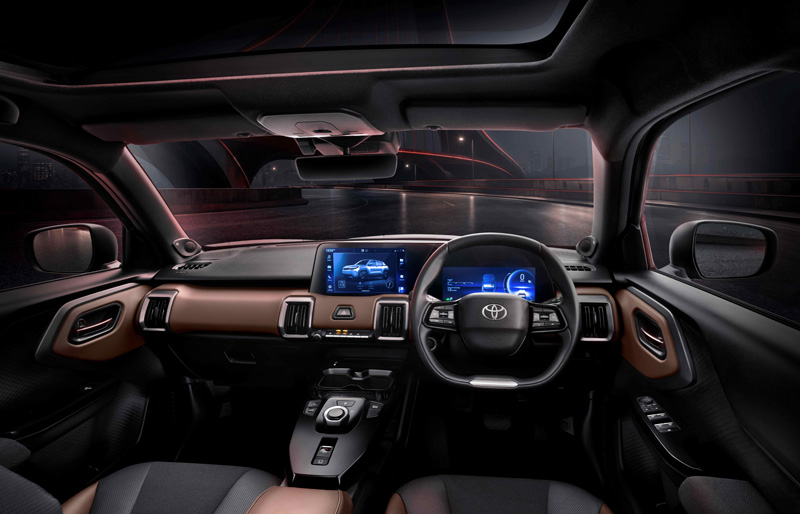
Those dual screens and ambient glow? It’s like stepping into a lounge on wheels.
Safety First: Toyota’s Gold Standard Meets EV Realities
Safety’s never been a Toyota weak spot, and the Ebella upholds it with seven airbags, ABS with EBD, and a 360-degree camera as standard. The star? Level-2 ADAS, including adaptive cruise, lane-keep assist, and rear cross-traffic alert—features that could save lives in our unpredictable traffic. Expect a 5-star Bharat NCAP rating, mirroring its Maruti twin.
Electronic parking brake, hill-hold, and ISOFIX mounts round out the kit. In a segment where corners get cut, this feels reassuring—like having a co-pilot who’s always alert.
Toyota Urban Cruiser Ebella EV Price and Variants in India for March 2026
Pricing’s where eyebrows raise. Ex-showroom starts at ₹16 lakh for the E1 (49kWh base), climbing to ₹19-20 lakh for the E2 (61kWh mid), and topping ₹24 lakh for the loaded E3. On-road in Delhi? Add ₹2-3 lakh for insurance and rego. It’s pricier than the Tata Nexon EV (₹14-18 lakh) but undercuts the Hyundai Creta Electric’s ₹22 lakh entry.
- E1: Basics + 49kWh, single-screen setup, 6 airbags. For budget-conscious commuters.
- E2: 61kWh, dual screens, ventilated seats, full ADAS. Sweet spot for families.
- E3: JBL audio, HUD, powered tailgate. Luxury leanings.
With BaaS, you could shave ₹3-4 lakh off by paying per km—game-changer for high-mileage users.
How Does It Stack Up? Competitors in the March 2026 EV Arena
The Ebella enters a crowded ring. Its closest sibling, the Maruti eVitara, is cheaper (₹13.5 lakh start) but lacks Toyota’s service network. Tata Curvv EV offers better GC and V2L at similar prices, while MG ZS EV edges on boot space (448L). Hyundai’s Creta Electric brings Korean flair but shorter range (456km).
| Competitor | Starting Price | Range (Claimed) | Key Edge |
|---|---|---|---|
| Maruti eVitara | ₹13.5L | 543km | Affordability |
| Tata Curvv EV | ₹17.5L | 502km | Off-road chops |
| MG ZS EV | ₹15.5L | 461km | Bigger boot |
| Hyundai Creta Electric | ₹18L | 456km | Premium fit |
The Ebella wins on reliability and warranty, but value-hunters might look elsewhere.
Pros, Cons, and My Take: Is the Ebella Worth the Hype?
Pros:
- Stellar build quality and Toyota’s unmatched service.
- Impressive claimed range for intercity hops.
- Feature-packed cabin with safety tech galore.
- Smooth, refined drive that’s EV pure.
Cons:
- Steep pricing—feels premium but competes with cheaper options.
- Infotainment glitches could frustrate tech lovers.
- Modest boot and rear space for the size.
- No AWD or one-pedal regen—missed chances.
Look, I’ve driven enough EVs to know the Ebella isn’t revolutionary, but it’s evolutionary. In a market where batteries degrade and service centers ghost you, Toyota’s promise of “assured care” is gold. For urban families ditching petrol bills, it’s a solid bet—especially if you snag the BaaS deal. But if range is king and budget tight, peek at Tata first.
Wrapping Up: Get Ready for March 2026 Deliveries
As March 2026 approaches, the Toyota Urban Cruiser Ebella EV feels like the reliable friend you didn’t know you needed in the EV world. With its blend of tech, space, and Toyota toughness, it’s set to carve a niche for those prioritizing peace over pulse-pounding performance. Bookings are live—head to your nearest dealership or Toyota’s site to lock one in.
What about you? Highway warrior or city crawler? Drop a comment below; I’d love to hear if this sways your next buy. And if you’re hunting more EV intel, check our guides on best EVs under 20 lakh or EV charging tips for beginners. Drive safe, folks— the future’s electric.